They are cute and funny!
Vodafone launched a new character named zoozoo to promote their value added services. Vodafone zoozoo character is getting more popularity among all kind of people.
Read more!
Spiga
They are cute and funny!
Vodafone launched a new character named zoozoo to promote their value added services. Vodafone zoozoo character is getting more popularity among all kind of people.

Three months after Satyam Computer Services was hit by a massive accounting fraud, Tech Mahindra won an auction for a controlling stake in the high tech giant.
On Monday, Tech Mahindra agreed to buy a 31 percent stake in Satyam for $351 million, edging out other bidders. The bid has to be approved by the government.
In January, Satyam's founder, B. Ramalinga Raju, shocked investors by admitting the company's profits had been overstated by more than $1 billion. The fraud had been going on for years, and it raised doubts about the survival of the I.T. giant, at that time India's fourth largest outsourcing company.
The country was rocked by its biggest corporate scandal, and the government moved quickly to protect the image of its booming Information Technology sector. It sacked the board of directors and appointed a new one, which set out to find a customer for the company.
Satyam Chairman, Kiran Karnik says the sale signals a new stage, and will restore customer confidence in the outsourcing company.
"We are very pleased," he said. "We think it is a very valuable company, we view this as a very successful event today."
The Satyam scandal has also raised questions whether accounting standards and corporate governance are adequate in India.
After Satyam's sale was announced, Indian Prime Minister Manmohan Singh gave assurances that a similar scandal will not be repeated.
"I am confident that our regulatory system has the resilience and the strength to ensure that no such "Satyam" will ever take place," he said.
Satyam has about 53,000 employees and operates in nearly 70 countries. Its clients include some of the world's largest corporations like U.S.-based General Electric. Satyam is listed on the New York Stock Exchange, and faces several lawsuits in the United States.
In recent months, India's I.T. sector has been reassuring customers that Satyam represents a "stand-alone" case. The $50 billion I.T. industry has grown massively in the last two decades.
Read more!

unbranded Chinese mobiles that do not have IMEI (International Mobile Equipment Identity) numbers and pose a serious security risk.
All mobile phone service users have been directed by the Department of Telecom (DoT) to disconnect these phones. In fact, two deadlines - January 6 and March 31 - have already been missed by the companies. Now they have undertaken to acquire the necessary equipment to track these phones by April 15 and discontinue their services thereafter - a process that is expected to take another 15 days, that is, by April 30.
Under law, all GSM phones are required to have a unique IMEI number that gets reflected at cell phone towers with which, if required, the location of a mobile phone user can be tracked. These Chinese phones, however, show up as a series of zeroes at cell towers or by their cloned IMEI number. Either way, they can’t be tracked.
The CBI first pointed out the risk to the Union home ministry which took up the issue with DoT. In turn, DoT has instructed service providers to disconnect all phones without IMEI numbers. The service providers, according to DoT sources, have dragged their feet "despite the obvious security risk to the country."
Service providers told TOI they needed to equip themselves with Equipment Identity Registers which would allow them to check if calls are from legal or fake phones. EIRs, they said, would be with all by April 15. The weeding-out will then begin.
8 lakh Chinese cells enter India every month
The security risk from unbranded Chinese mobiles, to be phased out by the end of this month, can be guaged from the fact that a number of bombs have been triggered by terrorists by these phones. Mobile phones are part of terrorists’ essential equipment, for getting instructions from their handlers or for passing on information. If they use legal phones, their location can be found by IMEI numbers.
To give an example, after the Mehrauli blast the terrorists melted away without a trace. However, assuming that they had mobile phones, it should have been possible to track them down by zeroing in on all the phones that started to move away from the blast site immediately after the bomb went off. Instead of blindly putting roadblocks across the city, the security forces could have pinpointed all suspicious post-blast movements and caught the terrorists.
Security forces believe that, as it appears in the Mehrauli case, terrorists have taken to these unbranded Chinese phones to mask their movements. Currently, about 7-8 lakh Chinese phones come into the country every month. This figure was much higher before the talk of their ban started - in September 2008, 1.5 million of these phones came into India.
Naturally, not all of them are used by terrorists (only their easy availability makes them readily available). These phones are popular with consumers because of their low cost, often less than half the price of branded phones. That’s why service providers are seeking time to inform these users to change their handsets.
Sources in the home ministry, which first took up the issue with DoT in August last year, said "the problem of combination of IMEI numbers" has forced DoT to recognise the security risk and order a blanket ban on them.
"Combination of IMEI numbers", or many phones with the same IMEI number, happen because the number is cloned in lots of 100, 1,000 or 5,000 phones by makers of unbranded Chinese mobile phones. This makes it impossible to trace a call or to locate a particular phone.
Read more!

Using equipment costing about $80, researchers from Inverse Path were able to point a laser on the reflective surface of a laptop between 50 feet and 100 feet away and determine what letters were typed.
Chief Security Engineer Andrea Barisani and hardware hacker Daniele Bianco used a handmade laser microphone device and a photo diode to measure the vibrations, software for analyzing the spectrograms of frequencies from different keystrokes, as well as technology to apply the data to a dictionary to try to guess the words. They used a technique called dynamic time warping that's typically used for speech recognition applications, to measure the similarity of signals.
Line-of-sight on the laptop is needed, but it works through a glass window, they said. Using an infrared laser would prevent a victim from knowing they were being spied on.
The only real way to mitigate against this type of spying would be to change your typing position and mistype words, Barisani said.
In the second attack method, the researchers were able to spy on the keystrokes of a computer which was using a PS/2 keyboard through a ground line from a power plug in an outlet 50 feet away.
"Information leaks to the electric grid," said Barisani. "It can be detected on the power plug, including nearby ones sharing the same electric line" as the victim's computer.
The researchers used a digital oscilloscope and analog-digital converter, as well as filtering technology to isolate the victim's keystroke pulses from other noise on the power line.
Their initial test, which took about five days to prepare and perform, enabled them to record individual keystrokes but not continuous data such as words and sentences, though they expect to be able to do that within a few months, Barisani said.
In addition to being used to sniff a neighbor's keystrokes in a nearby room, the attack could be used to sniff data from ATM machines that use PS/2 or similar keypads, Barsani said. The attack does not work against laptops or USB keyboards, he said.
The attacks are similar to other recent research that involves sniffing keystrokes through a wireless antenna.
And of course there is the big daddy of these types of remote sniffing attacks, TEMPEST, which allows someone with a lot of expensive equipment to sniff the electromagnetic radiation emanating from a video display.
The new attacks are easier and can be accomplished at lower cost, the researchers said.
Read more!
President-elect Barack Obama checks his BlackBerry while riding on his campaign bus in Pennsylvania last March.
(Credit: Pete Souza/ Rapport Press)
President-elect Barack Obama is sure to face his share of hurdles over the course of his presidency. But when it comes to one of them--the possibility that he might have to give up his beloved BlackBerry--he is waxing optimistic that he will overcome.
In an interview with CNN Friday, Obama expressed confidence that he would be able to keep his smartphone, despite well-publicized concerns over the possibility of eavesdropping by hackers and other digital snoops. While Research In Motion offers encryption, the U.S. government has stricter requirements for communications security.
Some handheld devices, such as General Dynamics' Sectera Edge, have been officially blessed as secure enough to handle even classified documents, e-mail, and Web browsing.
But Obama seems determined to hang on to his device of choice.
"I think we're going to be able to beat this back," Obama told CNN's John King. "....I think we're going to be able to hang onto one of these. Now, my working assumption, and this is not new, is that everything I write on e-mail could end up being on CNN. So I make sure that--to think before I press 'send.'"
Obama senior adviser David Axelrod told ABC News: "He's pretty determined."
The matter of the BlackBerry has been widely discussed in the media, not only because it represents security challenges specific to the BlackBerry era, but because Obama describes it as a symbol of his desire to stay in touch with the world outside the presidential bubble.
"I applaud that (desire)," Paul Begala, a CNN political contributor and former adviser to President Bill Clinton wrote in a commentary earlier this month. "And so I'm on his side in the Battle of the BlackBerry."
Research In Motion couldn't have paid for a better ad campaign.
Of course, the BlackBerry isn't the only consumer electronics device to share a headline with the president-to-be recently. Questions over whether Obama owned a Microsoft Zune had gadget watchers all aflutter late last year.source: cnet.com
Read more!
 Security researchers are reporting that in the past four days a worm has infected 3.5 million Windows computers.
The rapid-fire spread of a close-up photo of the US Airways plane that crashed in the Hudson River Thursday resulted in the service that hosted the picture going down.
According to Noah Everett, the founder of TwitPic, who still runs the service by himself, after the photo of the plane was re-tweeted by a large number of people and then picked up by several news sites, including Silicon Alley Insider, the resulting traffic was too much for the site's servers.
Everett called it a "snowball effect."
In fact, Everett said this wasn't the first time someone had used TwitPic to post a photo of an airplane accident. He explained that a passenger on a Continental Airlines plane that went off the runway in Denver in December used the service to post a photo. But that time, the service was able to stay up.
Perhaps because of the national interest in an airplane accident taking place in direct view of Manhattan, the traffic produced by Krums' photo was higher than in the case of the Denver accident, Everett suggested.
And while the circumstances of Thursday's accident were unfortunate--though, miraculously, no one died in the crash--Everett admitted that the fact that Krums' photo got so much attention was validation of the utility of TwitPic.
"We haven't gotten so much press coverage before," Everett said.
"It's shocking, and it's a good feeling--though (also) not a good feeling because it's bad news," Everett said.
He also said that he's got additional servers that are soon going to be in place.
"In a month's time (something like) this will not affect us anymore," he explained. "We're working to be able to handle our growth, but this is definitely a wake-up call showing the power of breaking news and TwitPic."
Everett said that there had been about 7,000 views of the picture before the site went down, and that there were about 500 additional requests to view it every 15 or 20 seconds.
He also said that while he couldn't be immediately sure, it was likely that Krums had used an Apple iPhone to take the picture, given that it was 600x800 pixels, the average size of an iPhone picture.
By 2:35 p.m. Pacific, about two hours after the photo was taken, TwitPic was back up.
Everett said, "I hope it stays up. I'll be working on this through the night."source: news.cnet
Read more!
Winners of high-performance computing project contest announced at Rusnanotech
(Nanowerk News)
A ceremony of awarding the winners of high-performance computing project contest held by the Russian Corporation of Nanotechnologies (RUSNANO) and Intel took place today. The contest was aimed at fostering the teams of scientists using the supercomputing power in their work.
The ceremony was carried out in the framework of the Nanotechnology International Forum at the Central Exhibition Complex "Expocenter". The criteria of evaluation the projects submitted to the panel of judges were using the high-performance supercomputers for scientific needs, adequacy of the level of tasks being set to the high-performance computing capacity, paralleling efficiency and scaling ability, absolute performance required to achieve the desired results, ingenuity and complexity of application implementation.
Winners of high-performance computing project contest announced at Rusnanotech
The projects had been accepted for contest until November 10. The works of 33 teams were accepted from Moscow and Moscow Region, Saint-Petersburg, Volgograd, Vladivostok, Kazan, Komsomolsk-on-Amur, Novosibirsk, Omsk, Yaroslavl (Russia), Lugansk and Kharkov (Ukraine), and other cities.
The panel of judges consisted of 12 representatives of research institutes and universities. The judges decided to award winners with five prizes.
The Intel Corporation is well used to popularizing the IT-industry. We hold various contests between students, young scientists and IT-professionals on a regular basis, which promote the high technologies in Russia and other CIS countries, - noted Dmitry Konash, regional director, Intel Russia & CIS. – By arranging the contest of projects in the field of high-performance computing we planned to discover the scientific teams which are able to realize effectively the potential of newest supercomputers. The panel of judges received 33 works and each one of them is worth to be represented on the international level. We consider the contest successfully completed with outstanding results. The Intel Corporation in Russia and CIS plans to hold such competitions each year.
Successful usage of the exact numerical calculations is a key tool which will allow our scientists, engineers and industrialists to earn an appropriate place on the market of nanomaterials and nanotechnologies – said Alexander Losyukov, RUSNANO deputy director general. – Due to the complexity of nanostructures all serious works require preliminary modeling and computations to evaluate the perspectives of practical implementation on further stages of the way down to mass production. We welcome the teams intensively using computational methods in their work and hope that more such crews will cooperate with our Corporation in future.
No valuable results can be expected without high-performance computing in many fields of modern science. It’s especially important in physics, chemistry, astronomy and nanotechnology – disciplines requiring in the first place processing of huge amounts of information within the multi-criteria models with unobvious cross coupling, – outlined Boris Chetverushkin, Director of Institute of Mathematical Modelling of Russian Academy of Sciences (RAS). – It wasn’t an easy task to select the winners of the contest. We are glad that Russian specialists can be proud of themselves in this case – both in Russia and worldwide.
Contest results
The first prize in the amount of 250 thousand rubles, was given to the work "FPIC3D – parallel code for modeling the processes of ion beams interaction with solid-state matter", submitted to the contest by Igor Lomonosov, professor of the Institute of Chemistry Physics Problems of RAS (Chernogolovka, Moscow Region). D.A. Grigoriev, V.V. Kim, A.V. Matveichev, A.V. Ostrik, V.G. Sultanov, A.V. Shutov also took part in the project.
Four more works were awarded special prizes:
The prize for the best project in the field of high-performance computing for nanotechnology and nanoindustry in the amount of 250 thousand rubles was awarded and split between two works:
Using supercomputers in constructing the nanomagnets was submitted by an international team of authors: A.I. Lichtenstein, (professor of the University of Hamburg, Germany), E.V. Gorelov (Institut für Festkörperforschung Forschungszentrum, Jülich, Germany), Yu.N. Gornostyrev (CJSC Institute of quantum materials science», Magnitogorsk), A.I. Poteryaev (Metal Physics Institute, Ekaterinburg), A.N. Rubtsov (Moscow State University Physics Faculty); and
Modeling the properties of nanomaterials using the methods of classical and quantum dynamics, submitted by the head of laboratory of the United Institute of High-Temperature of RAS (OIVTRAN) Vladimir Stegailov. The work was co-authored by members of OIVTRAN and Moscow Institute of Physics and Technology (MIPT) G.E. Norman, A.Yu. Kuksin, A.V. Yanilkin, S.V Starikov, P.A. Zhil’aev, V.V. Pisarev, O.V. Sergeev.
The Intel prize in amount of 250 thousand rubles was split between the two teams: A.V. Frolov, R.M. Vilfand, E.D. Astakhova, Yu.V. Alferov, V.I. Tsvetkov, T.Ya. Ponomareva with the work “Numeric modeling of atmospheric processes aimed at forecasting the weather using the spectral method” from the State Computational Centre of Hydrometeorological Centre of Russia and Yu.G. Evtushenko, I.Kh. Sigal, M.A. Posypkin, A.L.Ignat’ev with the work “Library for solving the tasks of finite-dimensional optimization on the multi-processor computational systems” from the Dorodnitsyn computational center of RAS.
Every contest winner team also received the grant for one oral presentation at the international conference for supercomputing, the Intel software certificate for development of the projects in the field of high-performance computing and access to the largest Russian supercomputing facilities in the RAS Joint Supercomputing Center, Moscow State University and the Siberian Branch of RAS.
President-elect Barack Obama embraced YouTube when he started broadcasting his weekly address in both audio and video form, so it may have only been a matter of time before the Congress followed suit.
YouTube in conjunction with Congress on Monday launched two new platforms, the Senate Hub and the House Hub, that provide easy access to congressional YouTube channels.
Visitors can find their senators' YouTube pages by clicking on a map or using a drop down menu. While Washington, D.C. has no members to boast in either chamber, clicking the capital city on the map will take visitors to channels dedicated to congressional committees. While the hubs are maintained by YouTube, each individual congressperson's channel is maintained by his or her office.
The pages feature playlists like "Got a Question?" and "Behind the Scenes." Videos featured allow visitors to watch clips of floor speeches, committee hearings, and other activities on the Hill.
While some members of Congress may enjoy futzing around on the Internet as much as the next guy (in this video, Rep. Tim Ryan of Ohio proves his Internet savvy on Facebook), the 111th Congress marks the first full session in which senators and representatives can officially use third-party sites like YouTube. Both chambers voted for the rule change in the fall of 2008.
"While we may not see eye-to-eye on everything," House Majority Leader Nancy Pelosi (D-Calif.) says in a welcome video, shown below, "one thing we can agree on is the importance of utilizing technology to communicate with constituents."
 Analysts are warning Satyam's customers to prepare themselves against the risk of disruption of services from the troubled outsourcer.
NVIDIA exclusive video card partner selling NVIDIA chipset motherboards and graphics cards. XFX and AMD have announced today that XFX is now an AMD partner and will be bringing XFX branded ATI video cards to market.
According to XFX, it will bring ATI Radeon HD 4000 series GPUs to market in early 2009. This is great news for gamers who like XFX's support and fantastic warranty that covers the original owner and the second owner for the lifetime of the video card. I hope this means we will see ATI overclocked video cards coming from XFX as well.
"In the world of PC gaming, XFX is synonymous with the extreme performance that enthusiasts crave," said Rick Bergman, senior vice president and general manager, Graphics Products Group, AMD. "Their decision to partner with AMD and launch AMD GPU-based XFX graphics cards, including the ATI Radeon™ HD 4870 X2, widely regarded as the world’s fastest graphics card1 by technology enthusiasts around the world, speaks to the level of excellence achieved by the ATI Radeon HD 4000 series."source: XFX
Read more!

 Mozilla's $75 million total revenue.
A new e-mail that is circulating looks like it comes from CNN and links to a fake CNN Web page offering "graphic" video related to the Israel-Hamas conflict but instead hosts a Trojan that steals sensitive data, RSA said on Thursday.
When someone clicks on the video link on the fake CNN site an error message pops up urging the visitor to download the latest version of Adobe Flash Player. Clicking on the download link installs an "SSL stealer" Trojan that captures financial and other sensitive information, RSA said in a blog.
The Trojan looks for encrypted communications between the computer and known financial institutions and when it sees data being sent it diverts it to a malicious third-party, said Sam Curry, vice president of product management and strategy at RSA.
The social-engineering attack is different in that the e-mail pretends to come from a media company and then tries to steal financial data, he said. "Normally when you get phished they send you an e-mail pretending to be from a bank or other financial institution," he said.
After the Mumbai terror strikes, anti-India elements in Pakistan are now
planning an attack on Indian computer networks, intelligence agencies
have warned. Already Pakistani hackers are trying out a dry run against
Indian networks through popular websites registered there after the
Mumbai terror strikes, Home Ministry sources told PTI here today.
"Every time the relations between the two countries dampen, Pakistanis
start attacking Indian computer networks and this has increased after
the Mumbai terror attacks," a Home Ministry source said. Pakistani
hackers have created websites such as the songs.Pk,
www.Songs.pk
Top 10 search providers for November 2008, ranked by searches (U.S.)
(Credit: Nielsen Online)It’s been a maelstrom of a year. Besides some of the fiercest financial and personal storms during 2008, we have also seen hackers ma
king their way into our systems through browser and OS glitches -- and sometimes just by the foolhardy way we click on links and attachments.
While most of the holes have been plugged, there are still a few bad eggs out there that are looking forward to making 2009 harder for us. The tech-threat landscape looks bleak, but nothing that can’t be changed if we take a few well-timed precautions...
Portable threats
Portable storage devices, such as flash drives and standalone hard disks, will be one of the biggest risk factors of 2009. These devices are easily shared amongst a group of users; so, if one such device is infected, it could end up compromising entire networks and groups. End Point Security is going to be a major concern area for both networks and home users.
And then, of course, there are PDA phones. These devices provide a new gateway to hackers through malicious codes in spam emails and websites around the Internet.
Social networking
Sites such as Facebook, MySpace and Orkut are sitting ducks for cyber criminals. Their goal: To collect information from user profiles that can later be used in other targeted attacks.
Using the information, scammers could send messages that resemble legitimate correspondence from trusted sources, such as friends and relatives.
Pod slurping
The term describes the act of using a portable data storage device such as an iPod to illicitly download confidential data by directly plugging it into a computer where the data is held.
As MP3 players become smaller -- coupled with an increase in their storage capacity -- they become an increasing security risk to companies, wherein employees could use them to copy classified information.
Most companies in 2009 would find it prudent to have rules in place with regards to cellphones, MP3 players and personal flash drives.
Read more!
The year that went by set the foundation for those technologies that are expected to take off in 2009, with focus on energy efficiency and mobility - a bit greener and a lot more faster.
Here are 10 of them to watch out for this year:
Mobile Applications:
With the India’s mobile telecom network expected to grow from over 300 million subscribers now to over 400 million by the end of 2009, mobile applications (m-apps) will become central to entertainment, information, banking and other services - and, of course, revenues for telecom companies.
You’ll see many m-payment services, and banks will urge you to use SMS and m-banking. The media will get serious with the platform, with SMS, mobile web, widgets and m-apps.
And m-marketing… expect lots of SMS spam and the failure of do-not-disturb lists, until a service provider gets taken to court.
The mobile will drive a host of apps: global positioning system (GPS), digital photography, music distribution. These started off earlier, but will really take off in 2009. Your phone will be at the centre of a converged, digital universe. With 3G technology, and 16 GB of storage, it’ll be your storehouse, your credit card, your identity.
Green Energy:
The world is energy-starved, and this influences product development. Especially with mobile devices, which need to stretch battery life to handle 3G and multimedia.
Laptops are moving from a four-hour battery life to eight hours. While we do have long-life laptops (over 20 hours), they are not the norm. Low-power processors and displays, flash memory, and newer software will help more laptops move to the high-battery-life band.
The ‘Energy Star’ logo will adorn appliances and adapters. And policy will drive stricter energy standards for appliances (and cars), and e-waste and disposal laws by year-end. But the disappointment will come from batteries, as this tech won’t see a quantum leap. So your overloaded mobile phone will last even less on a charge.
Green Lighting:
Lighting will shift to compact fluorescent lamps (CFL). They consume less power and last longer, and you spend less on backup. Their high cost means that we’ll see more power utilities subsidising CFLs.
You’ll also see more LED lighting. Already popular for traffic lights and pocket torches, they’ll enter areas where long life and low power offset high initial cost: vehicle and aircraft cabins, and some homes and offices.
One will also see electro-luminescence or EL, which has for years lit aircraft cockpits and ‘Indiglo’ watches. EL panels cover large areas - backlighting a ceiling or wall, drawing less power than a small light bulb.
Global Positioning System:
GPS entered the Indian market in 2007 with maps. Last year saw several products, and software for phones - especially Google Maps and Nokia Maps.
In 2009, GPS will enter sub-Rs.10,000 mobile phones — and midrange cars.
Up ahead will be 3D GPS landmarks. Nokia Maps 3.0 is testing this for its devices (check http://www.nokia.com/betalabs to see if your phone is compatible). And new tech will combine real-time video with turn-by-turn directions, as with Blaupunkt’s TravelPilot 500 “SafeDrive” navigation. The iPhone may also integrate Google Street View images with satellite data, to provide a similar interface.
Next Generation Networks:
Till 2008, India was stuck with second-generation mobile tech. We trailed in 3G, which Japan launched in 2001, South Korea in 2002. Over 40 countries had 3G networks by early 2008.
3G was finally launched in India last month by the state-run Mahanagar Telephone Nigam Ltd (MTNL) in the national capital. It will roll out in other parts of India, first from another state-run company Bharat Sanchar Nigam Ltd (BSNL) and then from Airtel, Vodafone and others by around mid-2009, thanks to the delay in spectrum auction.
3G allows fast internet access on the move and fixed access in hard-to-reach areas, without cabling. It spurs new services like mobile video and multimedia. You’ll see PCs and laptops with built-in 3G, like Qualcomm’s Kayak prototype. Many mid-range handsets are already 3G-ready, so you may not need to change your handset. But don’t expect WiMax taking off. While we patiently await it, 3G may overtake this always-around-the-corner technology.
Green Mobile:
The oil price swings of 2008 (up to over $140 a barrel, then down to under $40) were a gift for our planet. They forced the world to re-look at fuel-efficient cars. Sports utility vehicles (SUVs) went out of fashion. Even in the US, buyers bought smaller cars and hybrids. In India, the quirky Reva electric car generated interest again, and the Civic Hybrid was sold out on a discount scheme.
The car tech of 2009 will centre around fuel efficiency. Honda’s all-new City will pick up some ‘Car of the year’ awards, with its blend of space, superb power, and driveability, combined with fuel efficiency.
You’ll see more hybrids in India, and a range of electric vehicles - from buses to two-wheelers. The fuel cell will power some car models, globally. Other car tech for 2009 will include night vision, head-up displays, fog-penetrating laser scanners… and an advanced anti-collision system from Mercedes (who gave us airbags and ABS). The system brakes automatically, bringing the car to a stop if necessary.
The Netbook:
We saw the Asus EeePC last year, and then other netbooks - ultra-portable, minimalist but connected notebook computers at Rs.20k to 30k. Rising global demand and Intel’s low power Atom processor are helping flood the market with netbooks.
The Interface:
The way we interact with devices is changing. Touch is supplementing the keyboard. The iPhone’s multi-touch is reaching laptops. Lucid touch will let you point and touch from behind the display (so that your fingers don’t block the screen). Non-contact interfaces (remember Tom Cruise in Minority Report?) will emerge. And folding displays, and e-paper. But the disappointment is that speech recognition is still impractical.
Content Delivery:
Next in 2009 is a TV set-top box that is your connection to the world: high-speed internet access, an HD movie source for all your TVs, a Wi-Fi source for all your mobile devices, game consoles, laptops. It will store several hundred hours of HD video-and support telephony and VoIP.
High Definition Television:
High Definition TV sets are in many homes, but there’s no HD content. While Blu-Ray movie titles come in slowly (expect price cuts late in 2009), DTH operators will start off a few HD channels. The real move to HDTV will be around the Delhi Commonwealth Games next year. But the first HD push will come in at Indian Premier League (IPL) 2009.source: theindian
Read more!
MacBook Pro
It’s a bit heavy. But Apple lovers wouldn’t mind. At around 2kg and Rs 1 lakh, Apple’s new MacBook Pro is a sturdy step up from its predecessors. The concept of many parts has been with just one. That one part is called the unibody — a seamless enclosure carved from a single piece of aluminium. And then, the Pro boasts also of small details such as the multi-track touch pad that make computing not only look but feel good as well. Price: Rs 1 lakh
PSP 3000
So, you are a big kid now. Well, we have the right toy for you and it doesn’t cost the earth. At around Rs 9500, Sony’s PSP 3000 is a steal for gaming fanatics. The new version boasts of a web cam, Internet access and a microphone. And oh, you can play games on it too! Price: Rs 9,500
Blackberry Storm
Remember Terminator 2? In the sci-fi blockbuster, a liquid-metal T-1000 was sent from the future to bash up the ‘real terminator’ played by Arnold Schwarzenegger. Well, this time we have a new T-1000, the Storm, which is a new touch screen phone from Blackberry. It is all set to challenge the iPhone’s supremacy. The device offers extensive contact and scheduling applications, Wi-Fi access and the ability to add 16GB of storage with an SD card. Now, shall we call it — the Clash Of The Titans?
Canon EOS-1Ds Mark III
Special moments come and go with the blink of an eye. But if you want to hold on to a few, here is what you have to do. Gift a friend that delicate ultra slim digicam that you carry around. Soak in the surprise on his face. And then, go to the nearest Canon shop to pick up the latest EOS-1Ds Mark III. Be prepared to shell out a small fortune (Rs 3.99 lakh) for this 21.1 mp digital SLR. This is Canon
’s 7th EOS-ID series DSLR and can shoot up to 5 frames per second. Now, try and say cheese real fast!
Price: Rs 3.99 lakh
IWC Pilot’s Watch
It’s probably the gadget that everyone needs. And, of course for some, it goes much beyond that. If you have been craving for a watch, which is classy, yet minimalist, the Rs 9 lakh IWC Schaffhausen’s Pilot Watch seamlessly fits the bill. This mother of all IWC pilot’s watches has the dial of the original, a small seconds hand and a bi-directional adjustable rotating ring with the luminous triangle fitted from the inside. So, go ahead, spend some quality time. Price: Rs 9 lakh
HTC-Dream
Here’s another mobile handset to look out for. One of the first phones to use Google’s Android platform, the HTC-Dream has a QWERTY keyboard, touch screen functionality, various Android market applications...blah, blah. And, it looks good too.
Sony’s OLED TV
Okay. So you think you have seen it all. Or have you? 2009 might well turn out to be the year of the OLED (organic light emitting diode). OLED’s advantage over traditional LCDs is that it does not require a backlight to function. Hence, it draws far less power and can be much thinner than LCD panels. And at only 11 inches, Sony’s XEL-1 is the only available OLED TV in the world. Sony says it will launch a 27-incher by May this year. Will it find it’s way here? Keep your eyes peeled.
BeoSound 5
This one is for the thoroughbred audiophile. Bang & Olufsen, the Danish manufacturer of high-end audio and video products, will be launching BeoSound 5, a high-IQ digital media system. At around Rs 3.5 lakh, it runs on MOTS (an algorithm meaning ‘more of the same’). So, whenever you start playing your music on BeoSound 5, MOTS automatically scans your library and finds similar tracks based on parameters such as rhythm, syncopation and key tonality and not just genre or mood tags. And you don’t pay extra for lossless music and a sensual design. Price: Rs 3.5 lakh
CinemaOne
It’s smaller than a basketball, but is big on convergence. It fits in an iPod dock, a five-channel amp, six speakers and a subwoofer into its 10.75-inches across and 6.75 high frame. The Philips CinemaOne is one of the tiniest home theatre systems around. Its DVD player can cope with DivX, MPEG-4 and WMV, and upscales to 1080p over HDMI and the CD player can read MP3 discs, and it’s got an USB-in too.
Read more!
There's a scam spreading through Twitter. Direct messages (DMs) are showing up in Twitter accounts with appealing come-ons to visit a site on blogspot.com. The text is, "hey! check out this funny blog about you..." The URL in the message then redirects to a page that looks like the Twitter login page, but is actually not on Twitter--it's a site, twitter.access-logins.com, that masquerades as Twitter to steal your login credentials instead.
If you need to log in to Twitter, do it on Twitter.com itself. And to play it safe, double-check your browser address bar to make sure that's where you are.
The phishing site in question also appears to support the theft of Facebook IDs.
Twittersphere is abuzz over this scam.

This is not Twitter.
Read more on the Twitter Status blog, Chris Pirillo's blog, VentureBeat, or Mashable.
Update: If you are logged in to the real Twitter.com, you'll now see an update about this scam on the page. No warning appears if you use another Twitter client, like Twhirl.
Update 2: The effect of getting taken in by this scam seems to be that affected accounts send messages to their followers with the original phishing message. To date, no other effect of falling victim to the scam has been reported. However, since many people use the same user ID and password for multiple online services, it's possible that credentials collected from this scam could be used to log in to other services, including financial sites.
As Twitter recommends on its blog: "If this has you feeling a bit weirded out, feel free to change your Twitter password."
A denial-of-service attack that limits the number of SMS messages that can be received by Nokia smartphones has been disclosed and demonstrated.
Dubbed the "curse of silence" by German security researcher Tobias Engel, the attack occurs when Nokia Series 60 phones are sent a malformed e-mail message via SMS (Short Message Service). Engel demonstrated the attack on Tuesday at the Chaos Communication Congress in Berlin.The exploit is effective against a wide range of Symbian S60 smartphones and will effectively prohibit victims from receiving SMS messages.
An advisory made public by Engel on Tuesday gave details of the attack. After receiving a message from a sender with an e-mail address of greater than 32 characters, Nokia S60 2.6, 2.8, 3.0, and 3.1 devices are not able to receive any more SMS or MMS messages. The S60 2.6 and 3.0 devices lock up after one message, while 2.8 and 3.1 devices seize up after 11 messages.
Affected users must perform a factory reset of the handset to remedy the issue. No firmware fix was available at the time of writing. Performing a hard-reset is the only manual solution. And backing up the phone also backs up the exploit messages and the damaged messaging service. A Nokia representative on Friday the company was "aware of" the vulnerability, but believed it did not pose a significant risk.
"Nokia is not currently aware of any malicious incidents on the S60 platform related to this alleged issue and we do not believe that it represents a significant risk to customers' devices," said the representative. "Nokia believes that the vulnerability may be valid for some of the S60 on Symbian OS products. We are also working with the Symbian team to further investigate the vulnerability."
Products running S60 3rd edition, feature pack 2, are unaffected, said the representative, who added that the issue can be prevented by network filtering.
"According to our knowledge, many operators are looking into and actually already implementing network filtering to prevent the issue," said the representative.
F-Secure said on Tuesday that Sony Ericsson UIQ devices may also be vulnerable to this type of attack. On Wednesday the security vendor said the vulnerability will "most likely be used by jealous boyfriends," but that support personnel "should know what to look for" in case of harassment of staff.
According to Engel's research, the vulnerable phones fall into two camps: S60 versions 2.6/3.0 (2FP2/3) and versions 2.8/3.1 (2FP3/3FP1). That's still too many numbers, so let's just select two phones.
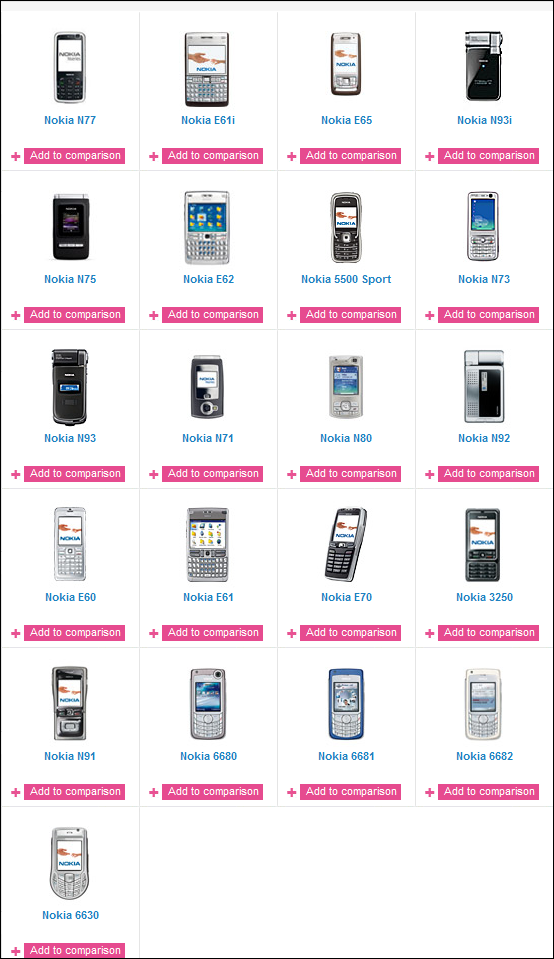
Nokia 6680 — 2nd Edition, Feature Pack 2
Nokia N95 — 3rd Edition, Feature Pack 1.
The vulnerability is very simple to exploit via an SMS message. No special software is required and the message can be drafted from a large number of phones. The message just needs to be formatted in a particular way.
What happens when a vulnerable phone receives the exploit message?
Example 1 — on the older 6680 nothing happens. Nothing at all… The first exploit message is enough to crash the SMS messaging service. It is a completely silent attack and there are no hints of trouble presented to the victim. The phone will simply stop receiving SMS (as well as MMS) messages.
Phone falling in 6680 category
Example 2 — on the newer N95, nothing will happen until several messages have been sent by the attacker. Then, once the critical limit has been reached, the phone will prompt an alert: "Not enough memory to receive message(s). Delete some data first."


.png "English")